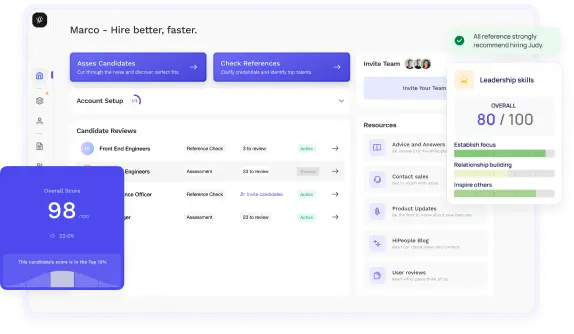
Vereinfachen Sie die Einstellung mit mühelosen Screening-Tools
Optimieren Sie Ihren Einstellungsprozess mit den KI-gestützten Bewertungen und Referenzprüfungen von HiPeople.
Optimieren Sie Ihren Einstellungsprozess mit den KI-gestützten Bewertungen und Referenzprüfungen von HiPeople.
Artificial intelligence is no longer an experimental technology. Organizations across every industry are integrating AI into daily workflows, decision-making, customer service, software development, marketing, and operations.
Yet despite widespread, many leaders still struggle to answer a fundamental question:
What is AI readiness?
More importantly:
How do you measure whether your employees can use AI effectively, responsibly, and safely?
This guide explores organizational AI readiness and risk, the skills that matter most, common mistakes companies make, and how HiPeople’s AI Readiness and Risk assessment can help organizations identify capability gaps before they become productivity, compliance, or security problems.
AI readiness is an organization’s ability to successfully adopt, use, govern, and scale artificial intelligence technologies.
At an individual level, AI readiness refers to a person’s ability to:
Many organizations assume AI readiness simply means having access to tools like ChatGPT, Claude, Gemini, or Microsoft Copilot. In reality, tool access is only one piece of the puzzle.
True AI readiness requires a combination of:
Organizations that focus on only one of these dimensions often struggle to achieve meaningful AI adoption.
AI adoption continues to accelerate, but actual employee proficiency remains highly uneven.
Within the same organization, you can find:
Without visibility into these differences, leaders cannot effectively prioritize training, governance, or AI transformation initiatives. This is why more organizations may be conducting an AI readiness audit before investing further in AI tools.
Organizations evaluating their AI maturity should ask:
If the answer to several of these questions is "no," an AI readiness assessment may be the logical next step.
The best AI readiness assessment tool does more than test knowledge.
It should evaluate:
Most importantly, it should provide actionable insights rather than a single overall score.
Organizations need to understand whether they should:
Different employee profiles require different interventions.
A useful AI readiness assessment framework should evaluate more than basic AI knowledge.
HiPeople’s framework assesses three distinct dimensions:
Knowledge measures what someone understands about AI.
Examples include:
Knowledge answers the question: “Do they understand how AI works and where it can fail?"
.png)
AI skills measure whether someone can actually use AI effectively.
Examples include:
Skills answer the question:“Can they produce useful, high-quality work with AI?"
.png)
Attitudes determine whether knowledge and skills will actually be applied.
Examples include:
Attitudes answer the question: “Will they use AI — and use it responsibly?”
.png)
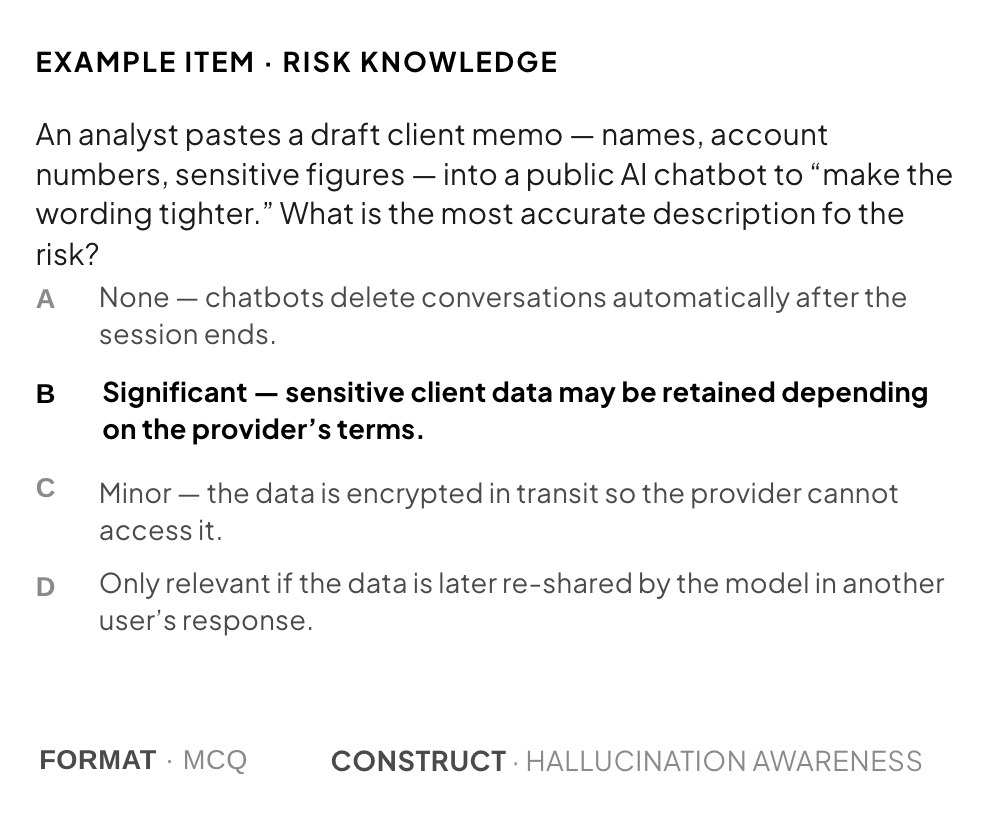
Many organizations focus exclusively on AI adoption and productivity. However, readiness is only half of the equation. The other half is risk awareness.
Employees must be able to identify:
Organizations that encourage AI adoption without addressing AI risk often create new vulnerabilities. That’s why HiPeople’s AI Readiness framework contains a Risk module to assess knowledge, skills, and attitudes related to risk tolerance and prevention.
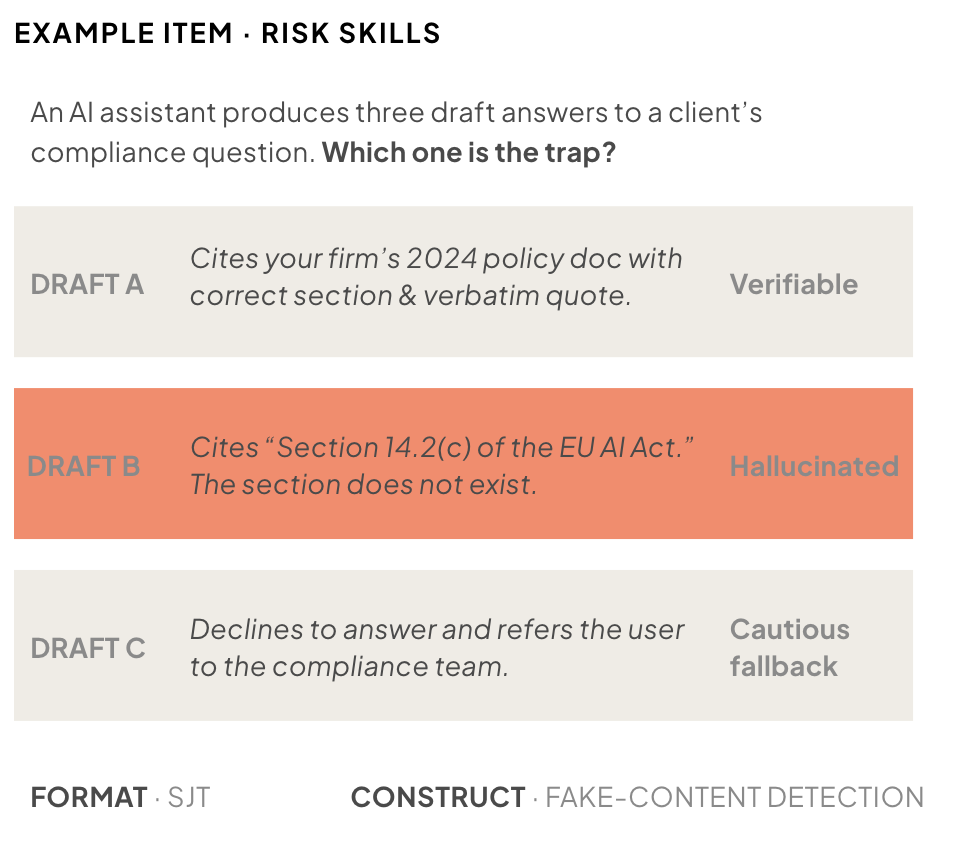

When using HiPeople’s assessment to assess both AI readiness and AI risk awareness, employees fall into four distinct groups.

High readiness. High risk awareness. These employees use AI effectively while understanding potential risks.
Recommended action:
High readiness. Low risk awareness. These employees move fast but often overlook governance, compliance, or quality concerns.
Recommended action:
Low readiness. High risk awareness. These employees understand risks but hesitate to use AI.
Recommended action:
Low readiness. Low risk awareness.
These employees are early in their AI journey.
Recommended action:
AI adoption is no longer a technology challenge. It is a people challenge. Organizations that succeed will not necessarily be those with the most advanced tools. They will be the organizations that develop AI fluency across their workforce while maintaining strong governance and risk awareness.
The future belongs to organizations that can answer two questions confidently: Can our people use AI effectively? Can our people use AI responsibly?
HiPeople’s AI readiness framework helps answer both.
If you are interested in testing HiPeople AI Readiness and Risk assessment you can get in touch with the team here.
.png)